

Shijiazhuang, Hebei, Chinasales@kaifil.com
KAIFIL
Filter media rolls and sheets

Sintered metal fiber felt sheets

Kaifil supplies stainless steel sintered fiber felt for pleated cartridges and porous filter components. The 0.5 mm sheet series combines 5–60 µm filtration grades with a porous metal-fiber structure.

Sintered metal filters and media
Filter medium
Sintered stainless steel fiber felt
Filtration grades
5 / 7 / 10 / 15 / 20 / 25 / 30 / 40 / 60 µm
Series thickness
0.5 mm
Porosity
75–79 %

Share a drawing, reference sample or application requirements to discuss the configuration.

Specifications

Sintered metal fiber felt sheets
ParameterSpecificationNotes
Filter mediumSintered stainless steel fiber felt—
Filtration grades5 / 7 / 10 / 15 / 20 / 25 / 30 / 40 / 60 µm—
Series thickness0.5 mm—
Porosity75–79 %Each grade has its own porosity in the structure table.
Stainless steel grades304 / 316L—
Air-permeability test differential200 PaTest medium: air.
Supply formsSheets / cut blanks / pleated media—
Support constructionBare felt / mesh-supported felt—

Materials: 304 / 316L stainless steel; Inconel; Hastelloy; FeCrAl

Product details

A sintered fiber network for depth filtration

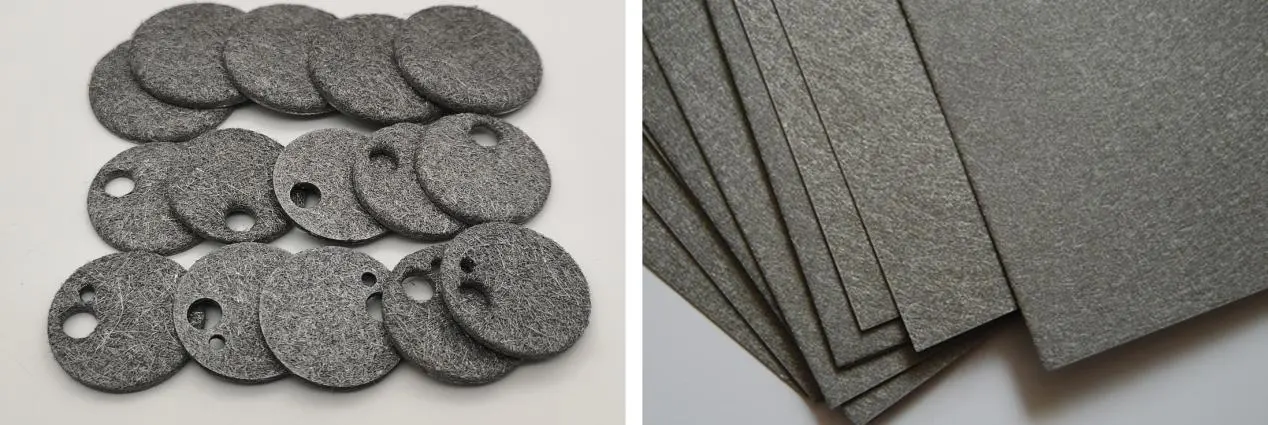
Fine stainless steel fibers form a porous nonwoven web. Sintering bonds the fiber contacts and gives the sheet a connected three-dimensional pore structure. Particles are captured through the fiber network, while the interconnected voids provide flow paths and space for collected solids. The material is used as flat media or formed into pleated filter elements.

A complete 0.5 mm grade series

The selected series keeps sheet thickness at 0.5 mm across nine filtration grades. The tables pair every grade with its air permeability, porosity and dirt-holding capacity. Air permeability uses air at a 200 Pa pressure difference. This gives buyers a consistent basis for comparing the flow and solids-capacity characteristics of the grades within this series.

Surface of sintered metal fiber felt showing the intersecting fiber network
The close-up shows the nonwoven porous structure and fiber intersections.

Pleating and support design

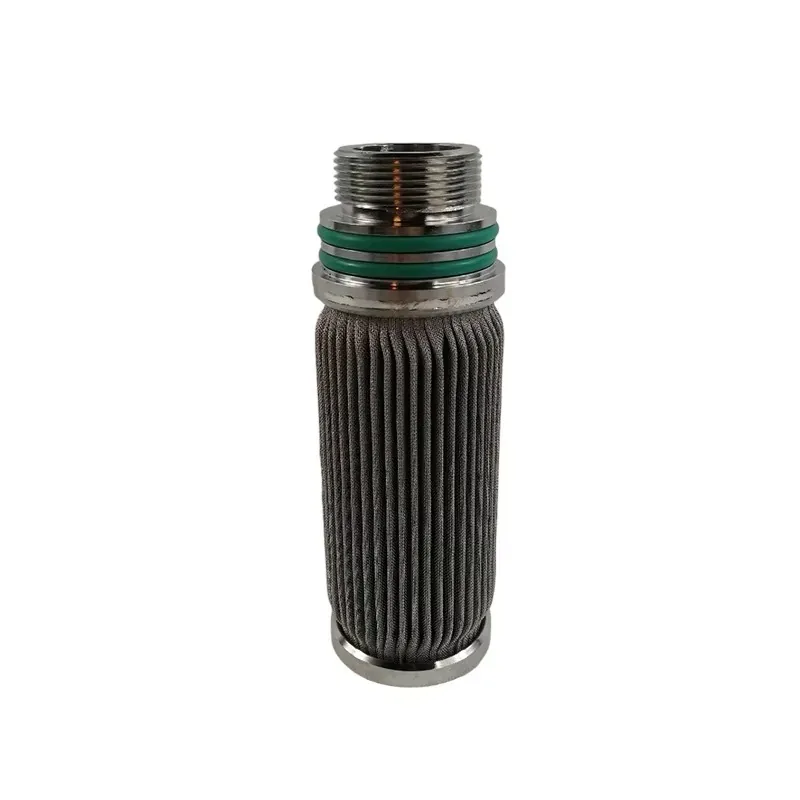
Pleating increases active area inside a cartridge envelope. Pleat height, spacing and count work together with an inner core and outer support to preserve drainage channels. Mesh-supported felt provides additional handling support during conversion. Mark the working face, cutting direction, seam width and end-cap joining area on the element drawing.

Choose media around the process

Start with the solids size and target retention, then add fluid viscosity, flow and available housing space. A higher solids load calls for an appropriate combination of medium grade and filtration area. For reusable elements, select cleaning chemistry and backwash conditions together with the support and joints. Measure recovery at the same clean-flow conditions after each cleaning cycle.

Choose the felt and its protective faces

The nonwoven fiber network is the filtering medium. A protective wire mesh adds handling support while retaining a separate role from the felt. Define which face carries the support, the flow direction and the final composite thickness. The 0.5 mm performance tables describe the stainless felt series; added mesh and finished pleats receive their own assembly dimensions.

Roll, flat blank and pleated element

Cut size defines the material blank. Pleat height, pitch and count define the developed surface inside the finished cartridge. The core and outer support preserve channels between pleats; the longitudinal seam and end seals close the filtration boundary. Keep fiber alloy, protective-mesh alloy, core and fittings as separate entries in the component specification.

Special fiber-alloy branches

Inconel and Hastelloy fiber felts form separate alloy options. FeCrAl felt is made from iron–chromium–aluminium fibers for burner, exhaust and hot-gas applications. Each alloy branch has its own fiber and support specification. The stainless 0.5 mm permeability and capacity series stays with its stated material construction.

Filtration grades and air permeability

Filtration grades and air permeability

The 0.5 mm series is compared using air at a differential pressure of 200 Pa.

Filtration grade (µm)Thickness (mm)Air permeability (L/min/dm²)
50.535
70.555
100.5100
150.5140
200.5260
250.5320
300.5480
400.5650
600.51100
Porosity and dirt-holding capacity

Porosity and dirt-holding capacity

Use the same filtration grade to connect each row to the flow table.

Filtration grade (µm)Porosity (%)Dirt-holding capacity (mg/cm²)
5755
7756
10797
15789
207715
257621
307526
407735
607738
Choose the felt and its protective faces

Choose the felt and its protective faces

ConstructionLayer definitionConversion route
Bare feltSintered fiber web with its two faces identifiedFlat blanks, discs and supported element fabrication.
Single protective meshFelt combined with a protective woven layer on one faceIdentify the mesh face on the cutting and pleating drawing.
Two protective meshesFelt between protective woven layers on both facesSpecify both mesh grades, composite thickness and seam margin.
Ordering and production

Ordering and production

Supply itemOrder basis
Production lead time2–3 weeks after order and drawing confirmation.
Trial ordersSmall trial quantities for fit and process evaluation.
Regular material ordersQuantity follows the selected roll, sheet or cut-length format; US$3,000 regular order value.
Quotation basisAlloy, media construction, wire or stock thickness, delivery format and quantity.

Selection guide

Include these details when discussing your requirements.

Compare grades within the series
Read filtration grade, air permeability and dirt-holding capacity as a paired set.
Plan the active area
Define flow, viscosity, solids loading, pleat height and available cartridge space.
Select support and joints
Specify bare or mesh-supported felt, inner core, seam and end-cap attachment.
Define cleaning
Identify the contaminant, cleaning chemical, temperature and reverse-flow conditions.

Applications

Pleated filter cartridges

Porous felt adds active filtration area through a compact pleat structure.

Polymer melt filtration

Metal-fiber media captures particles and gels in a supported melt-filter element.

Process liquid and gas filtration

Sheet and cylindrical constructions provide reusable porous media for equipment integration.

Frequently asked questions

How does fiber felt differ from sintered wire mesh?

Fiber felt uses a nonwoven depth structure. Sintered wire mesh uses defined woven layers bonded into a laminate.

Is thickness the same as filtration grade?

Thickness is the sheet dimension. Filtration grade describes the media rating; this series provides nine grades at the same 0.5 mm thickness.

What does dirt-holding capacity describe?

It expresses retained contaminant mass per unit filter area. Use it alongside permeability and the selected filtration grade when comparing the series.

What is needed for pleated-element fabrication?

Provide finished diameter and length, pleat height and count, support arrangement, seam, end fittings and cleaning direction.

Technical enquiry

Define the dimensions, media, joints and inspection records before confirming the order.

Technical details (optional)
Selection inputs

WhatsApp

Search